
David Schrock · August 14, 2018 · 12 min read
Drinking Deeply from Our Father in Heaven: Nine Observations about Giving, Praying, and Fasting (Matthew 6:1–18)
In the middle of the Sermon on the Mount, Jesus gives instructions about giving (vv. 2–4), praying (vv. 5–15), and fasting (vv. 16–18). In our church we have taken one sermon per "spiritual discipline," but really in the structure of Matthew's Gospel, we should read these three disciplines together. And in fact, when we do there are some observations we discover that we might not find on our own.
So here are nine observations about Matthew 6:1–18 and Jesus's instructions about these critical elements of worship, discipleship, and spiritual communion with God.
1. Giving, praying, and fasting make up the center of the Sermon.
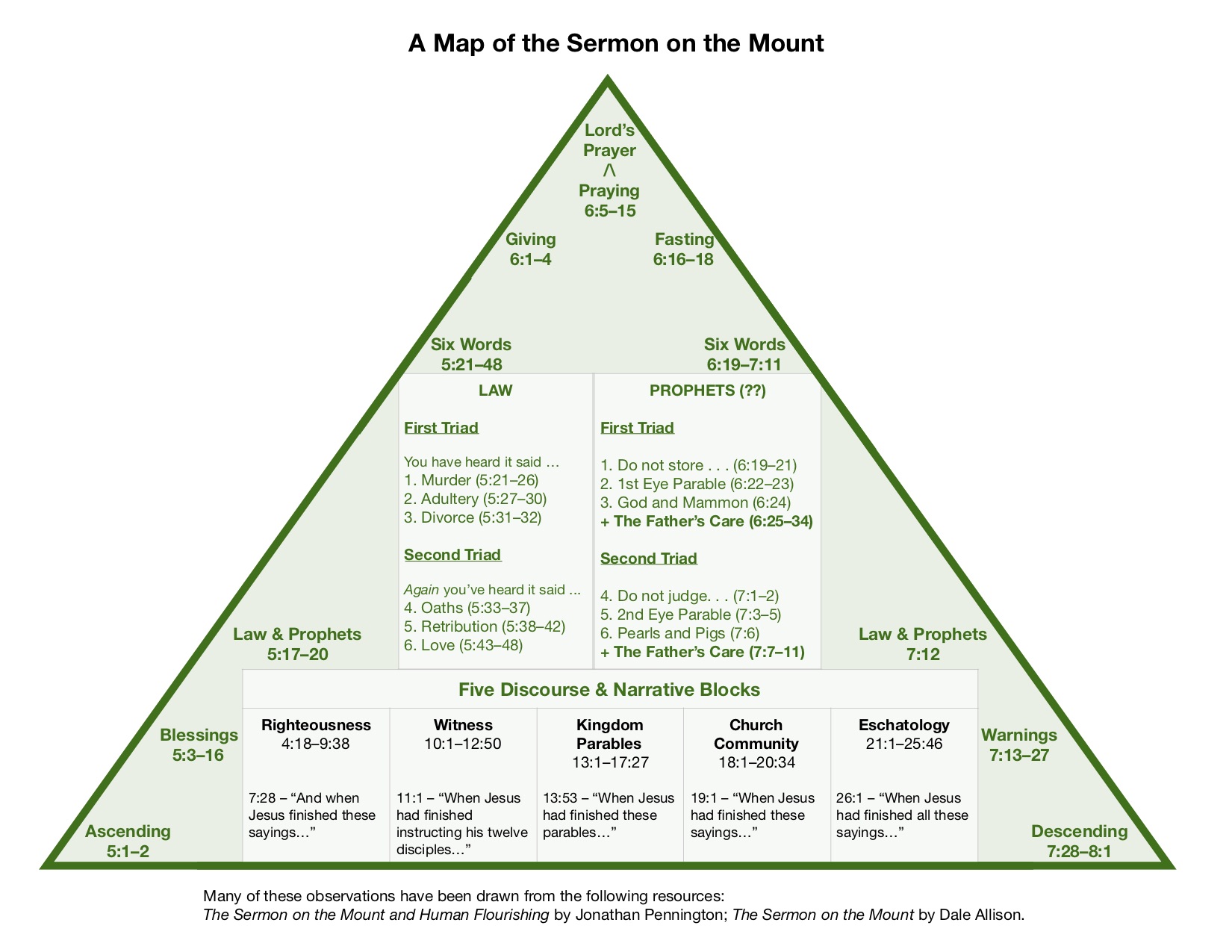 From the structure of the sermon, we discover verses 1–18 should be read as the center of the sermon. Even more specifically, giving (vv. 2–4) and fasting (vv. 16–18) should be seen as a concentric ring around Jesus's instructions around prayer (vv. 5–15), which itself is centered around the Lord's Prayer. And that pray too is shaped to put three imperatives on both sides the words "on earth as it is in heaven."
In other words, the shape observed in the image above continues right to the summit of the mountain, where we discover that prayer in the presence of our heavenly father is the goal of the Law (5:17–48) and the Prophets (6:19–7:11), as well asthe center of Jesus teaching about discipleship (6:1–18).
Moreover, because of this intentional shaping and the balanced presentation of giving and fasting around prayer, we may find that these various disciplines are not as independent as we often think. In fact, to get the full meaning of Jesus's words we should read them together.
2. We should read these verses together.
It could be generally assumed that we read these passages together, because they are contained in the same location, but even more then that, there are at least two textual clues for reading them as one point of instruction, not three.
From the structure of the sermon, we discover verses 1–18 should be read as the center of the sermon. Even more specifically, giving (vv. 2–4) and fasting (vv. 16–18) should be seen as a concentric ring around Jesus's instructions around prayer (vv. 5–15), which itself is centered around the Lord's Prayer. And that pray too is shaped to put three imperatives on both sides the words "on earth as it is in heaven."
In other words, the shape observed in the image above continues right to the summit of the mountain, where we discover that prayer in the presence of our heavenly father is the goal of the Law (5:17–48) and the Prophets (6:19–7:11), as well asthe center of Jesus teaching about discipleship (6:1–18).
Moreover, because of this intentional shaping and the balanced presentation of giving and fasting around prayer, we may find that these various disciplines are not as independent as we often think. In fact, to get the full meaning of Jesus's words we should read them together.
2. We should read these verses together.
It could be generally assumed that we read these passages together, because they are contained in the same location, but even more then that, there are at least two textual clues for reading them as one point of instruction, not three.
From the structure of the sermon, we discover verses 1–18 should be read as the center of the sermon. Even more specifically, giving (vv. 2–4) and fasting (vv. 16–18) should be seen as a concentric ring around Jesus's instructions around prayer (vv. 5–15), which itself is centered around the Lord's Prayer. And that pray too is shaped to put three imperatives on both sides the words "on earth as it is in heaven."
In other words, the shape observed in the image above continues right to the summit of the mountain, where we discover that prayer in the presence of our heavenly father is the goal of the Law (5:17–48) and the Prophets (6:19–7:11), as well asthe center of Jesus teaching about discipleship (6:1–18).
Moreover, because of this intentional shaping and the balanced presentation of giving and fasting around prayer, we may find that these various disciplines are not as independent as we often think. In fact, to get the full meaning of Jesus's words we should read them together.
2. We should read these verses together.
It could be generally assumed that we read these passages together, because they are contained in the same location, but even more then that, there are at least two textual clues for reading them as one point of instruction, not three.
- First, verse 1 is the heading for all three sections. It reads, "Beware of practicing your righteousness before other people in order to be seen by them, for then you will have no reward from your Father who is in heaven." This verse outlines the main point regarding giving, praying, and fasting. Jesus is not focusing here on an exhaustive study of spiritual disciplines; he is training new covenant hearts how to commune with God.
- In fact, second, each section repeats two critical statements related to true worship. First, Jesus identifies false worship saying three times: "Truly, I say to you, they have received their reward" (vv. 2, 5, 16). Second, each section repeats: "And your Father who sees in secret will reward you" (vv. 4, 6, 18).
- The Father sees in secret and invites us to come and find reward from him in private (vv. 4, 15, 18)
- The Father is the one whom the disciple addresses in prayer (v. 9). And actually, because it is "our Father," it is an invitation for the disciples collectively to come to God in prayer. (This should balance how we think about praying in secret).
- Moreover, the motivation for prayer is the Father's care (v. 8). This truth will be repeated in Matthew 7:7–11.
- Last, the children of God will look like their Father. Just as the Father overflows with mercy, so will his children. And if we do not, as proven by a heart of unceasing un-forgiveness, we prove that we are not his, and therefore, will not be forgiven (vv. 14–15).
- . . . when you give to the needy (v. 2)
- . . . when you pray (v. 5)
- . . . when you fast (v. 16)
- First, you won't be able to give sacrificially unless you are fasting. Or to turn it around, it will require self-restraint and self-denial in order to give generously to others. For an example of this, read 2 Corinthians 8–9.
- Second, if your giving is poor, you need to fast. In other words, rare is the person who giving sacrificially that is not fasting in some capacity. Why? Fasting teaches us what we really need. And generally speaking, we think we need more than we do. Only when we go without, do we learn what we need. Thus, again, fasting and prayer go together.
- Third, practically speaking, if your fasting is poor, let your desire to give impel you to fast. Here's the concrete reality: every time you give, you must choose to say "no" to something for yourself, in order to say "yes" to the needs around you. Thus, if you do not or cannot say "no" to yourself, you will be very challenged to say "yes" to others. But if you are practicing fasting (i.e., saying "no" to ourselves), then you will be ready to say "yes," and you will have means to do it.
Practicing Our Righteous in the Presence of God, So That Others May Join Us
Ultimately, all that Jesus says is for the purpose of bringing disciples of Christ into the presence of his heavenly Father. It is there where weary disciples find life-giving water. And thankfully, Jesus teaches us tangible ways for us to drink from God's fountain of life. And thus, if you are not giving, praying, or fasting, and you lament the fact that your are missing the joy of God's presence and strength, you can know why. Jesus teaches us that if we are parched and powerless in our spiritual lives, and we are not giving, fasting, and praying, it is because we are lacking these practices. At the same time, these invitations to personal communion with God are not meant to create disciples who leave world behind. Rather, giving is for the purpose of those who need. And fasting, according to Isaiah 58 and Acts 13 at least, are for the increase of justice and the advancement of the gospel respectively. Ordered rightly, heavenly-minded people are the most effective at bringing about earthly good. And that is exactly what we find in the center of these verses and the center of the Sermon---"on earth as it is in heaven." Truly, when we commune with God and drink deeply from his living waters it fills us and empowers to give to others. Feeding on him, we do not need things of this world to be full. Rather, we can "fast," and in our fasting we can serve others. This, I would argue, is the unified message of the summit of the Sermon. It is not a list of three spiritual disciplines; it is a call to communion with the Father, so that as disciples of the Son, we can go into the world and proclaim the life-giving message of the gospel. May God help us to draw near to him and then filled with his Spirit, bring the grace and truth of Christ to the world. Soli Deo Gloria, ds Photo by didin emelu on UnsplashBibleDiscipleshipFatherGodJesusMatthew 6
0 views0 comments
Recent Posts
See All

Leave a comment
Comments are read before they appear. Your email is never published.