January 31, 2020 · 17 min read
That You May Believe That Jesus is the Messiah, the Son of God: 10 Things about John's Gospel
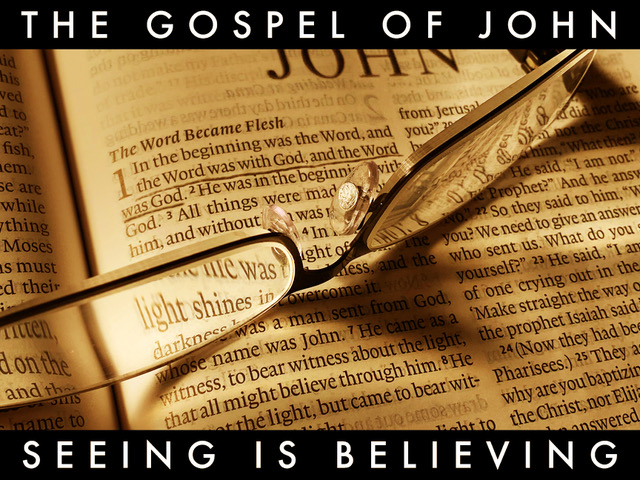 This Sunday we begin a new sermon series on the Gospel of John. As we prepare for that series here are ten things to keep in mind as we enter this incredible book.
1. John has a simple four-part arrangement.
If you want to understand a book's message, begin with its structure. And in John, we find a simple, four-part organization.
This Sunday we begin a new sermon series on the Gospel of John. As we prepare for that series here are ten things to keep in mind as we enter this incredible book.
1. John has a simple four-part arrangement.
If you want to understand a book's message, begin with its structure. And in John, we find a simple, four-part organization.
- Prologue (1:1–18)
- Book of Signs (1:19–12:50)
- Book of Glory (13:1–20:31)
- Conclusion (21:1–25)
Papias (at least to Eusebius) seems to refer to two separate Johns, the apostle and a “John the elder." On this basis some have conjectured that the latter, rather than the former, wrote the Fourth Gospel. However, there is no need to drive a wedge between the two references to John in the passage in question. To the contrary, John may be designated “the elder in the latter part of the quotation precisely because he is grouped with the elders mentioned earlier in the same passage. For a sound critique of the “John the elder” hypothesis, see Carson, Moo, and Morris, An Introduction to the New Testament, 1992: 141–43. (John, 7 n17).
Second, internal evidence points to John the apostle. For instance, Michael J. Kruger lists five evidences from the book that identify John, son of Zebedee, as Jesus's beloved disciple. He writes,(1) The beloved disciple is present at the Last Supper (13:23) and thus is presented as one of the apostles; (2) the beloved disciple is described as a witness (21:24) and as one present from the beginning (1:35–40), both attributes that Jesus uses to expressly describe the apostles in 15:27: “you also will bear witness, because you have been with me from the beginning”; (3) this individual is clearly none of the other named disciples (Peter, Philip, Judas, Thomas, et al.); (4) the beloved disciple is often in the company of Peter (e.g., 20:2; 21:20); and (5) John the son of Zebedee, one of the most prominent disciples, is never named (and if he is not the beloved disciple, then where is he?). (A Biblical-Theological Introduction to the New Testament, 117)
Third, the other choices raise questions about the Bible or impose unnecessary connections. Indeed, one's interpretation is impacted by who wrote the book. For instance, the dating of the book depends largely on who wrote it. Thus, for the reasons cited above, I believe John the apostle wrote the Gospel of John. 3. The Destruction of the temple (70 AD) plays an important part in the setting. Many will notice that the cleansing of the temple occurs at the beginning of the Gospel (John 2:13–22). This placement is unlike the other Gospels, which have Jesus's cleansing at the end. Why? One reason may be the background: the temple's destruction has come and now this gospel is going to stress how Christ is the true temple! John's prologue points (see John 1:14) in this direction and Michael Kruger gives us some historical context.Whereas the Synoptics record Jesus’s vivid predictions of the temple’s destruction (Matthew 24; Mark 13; Luke 21), John focuses on the theological implications of that destruction, namely, that Jesus is the embodiment of all that the temple was intended to be. No doubt this is why John places the story of Jesus’s cleansing the temple at the beginning of his Gospel (whereas it occurs at the end of the Synoptics).” This redemptive-historical perspective on Jesus as the new temple fits quite well with the end of the first century—80s or 90s—when Jews and Jewish Christians would have been reflecting upon the meaning of AD 70. (A Biblical-Theological Introduction to the New Testament, 118)
4. John's Gospel is like and unlike Matthew, Mark, and Luke. If you read the four Gospels, you will quickly realize one of them is not like the other. John's Gospel is unique in style, symbolic language, and theological content---to name a few. At the same time, it shares many similarities with the other Gospels. John does not present a different Christ or a contrasting theology about God. Instead, he gives us a complementary vision of the Son of God. The reasons for this distinct presentation are many, but let me mention three. First, John wrote his Gospel later than the rest. Writing in AD 80–85, he is the last of the Gospel writers, who wrote around AD 50–60. John may have even read the earlier three Gospels, so that adding a fourth from a similar perspective would be unnecessary. Second, the evangelistic focus towards Jews makes John's Gospel unique. Writing after the temple's destruction (AD 70), John presents Jesus as a greater temple for God's true people. As we will see, John's Gospel is filled with symbolism associated with Israel's temple and feasts. The historical context of John writing in a post-temple world explains why this theme is so prominent. Third, John's Gospel stressed Jesus's sonship and his relationship to the Father. This may also stem from his intended audience (diaspora Jews). In any case, John gives us a theological explanation of who Jesus is, the Son of God who is God and man. This theological aim does not deny the theological nature of the Synoptic Gospels (Matthew, Mark, and Luke), but it does explain something of the difference. John's Gospel also presents many of the same events in Jesus's life. His baptism, miracles (e.g., walking on water, feeding the 5000, etc.), last supper, crucifixion, and resurrection all harmonize with the Synoptics. Only better, in many places they give further information. As D.A. Carson and Andy Naselli observe,Impressive are the many places where John and the Synoptic Gospels represent an interlocking tradition, i.e., where they mutually reinforce or explain each other without necessarily borrowing from each other. . . . For example, the charge that Jesus had threatened to destroy the temple (Mark 14:58; 15:29) finds its only adequate explanation in John 2:19. . . Only John explains why Peter can be placed within the high priest's courtyard (18:15–18; cf. Mark 14:54, 66–72). (NIV Study Bible, 2143)
From this cursory look at the four Gospels we can begin to see the necessity of each book and the unique contribution John makes. 5. John's Gospel is a perfect combination of history and theology Many have wrongly concluded that the Synoptic Gospels are historical in orientation and John is theological. Yet, this errs in both directions. The "biographical" works about Jesus by Matthew, Mark, and Luke are filled with theology. Conversely, John is rooted in the historical events of Jesus's life. As Michael J. Kruger notes,In contrast to much of modern scholarship, ... [John’s] Gospel is based on real eyewitness history and, at the same time, presents a deep, rich theological vision for the person and work of Christ. And these two aspects are not mutually exclusive. Indeed, it is only when they are understood together, in a symbiotic relationship, that this Gospel can serve its proper function in the church of Christ. The historical dimension of the book gives us confidence that it is based on real events and therefore can be trusted. And the theological dimension provides a distinctive interpretation of those real events and a distinctive application to the life of the church. (A Biblical-Theological Introduction to the New Testament, 116)
In fact, we might take it a step further. In an argument that runs counter to many assumptions about John, Richard Bauckham has argued there is considerable reason for seeing history in John's Gospel. In his article, "The Historiographical Characteristics of the Gospel of John," he explains how John may be more historical than the other Gospels. He bases this on topography (the cities in John), chronology (John's attention to the festivals), selectivity, narrative asides, eyewitness testimony, and the discourses and dialogues found in John. Pulling all this together, he concludes,The evidence we have examined in this study strongly suggests that to its contemporaries the Gospel of John would have looked considerably more like historiography than the synoptic Gospels would. The historiographical characteristics discussed in the first half of this chapter [i.e., topography and chronology] align John closely with those ancient biographies that display some features typical of historiography best practice and most closely resemble works of historiography. The discussion in the latter part of the chapter [selectivity, etc.] has shown that the discourses and dialogue of Jesus in John's Gospel conform to good historiographical practice at least as well as those in the synoptics. (The Testimony of the Beloved Disciple, 112)
John's Gospel should not be relegated to theology only. Rather, it is theology grounded in history (and eternity). It is also history that employs symbolism to explain theology, as we will see next. 6. John's Gospel is symbol-laden. If John's Gospel is rooted in history, it is also filled with symbols. While some might place symbolism and history on opposite sides of the ledger, such a division between history and symbolism is a product of modern thought, scholarship, or preaching. In the Bible, symbolism and history (i.e., fact-based reality) run together. Indeed, the Garden of Eden was a real place, at a real time, with real people named Adam and Eve. And (not but) it was also a garden sanctuary, a prototype for the tabernacle of Israel. Just the same, Israel's history is filled with repeated events. The Exodus being the most important. While Israel crossed the Red Sea one time, the symbolism of this "baptism into Moses" (1 Cor. 10:2) would repeat in the days of Joshua, Elisha, Elijah, and Jesus. Even more, Moses wrote the stories of Genesis 6–8 (the flood) and Genesis 12 (Abraham's going down to Egypt) with patterns found in the historical exodus. This is the reason why Paul can say that Genesis was "written typologically," which is better than the ESV's "interpreted allegorically" (Gal. 4:24). God superintended history so that people, places, events, and institutions would "pattern" events that God would later bring to fruition in Jesus Christ. John knows this and fills his Gospel with symbolism---i.e., Old Testament shadows that find their substance in Christ. For sake of brevity let me mention four. (1) Seven Titles. In John's Gospel, we find seven titles in the first chapter of John's Gospel.- Lamb of God (1:29)
- Son of God (1:34)
- Rabbi (1:38)
- Messiah (1:41)
- Jesus of Nazareth (1:45)
- King of Israel (1:49)
- Son of Man (1:51)
- Water into wine (John 2:11)
- Healing a sick boy (John 4:54)
- Healing a paralyzed man (6:2)
- Feeding the 5,000 (6:26)
- Healing a blind man (9:16)
- Raising Lazarus from the dead (11:47; 12:18)
- Raising himself from the dead ("many other signs" 20:30)
- I am the bread of life (6:35)
- I am the light of the world (8:12)
- I am the gate (10:7)
- I am the Good Shepherd (10:11)
- I am the resurrection (11:25)
- I am the way, the truth, and the life (14:6)
- I am the true vine (15:1)
This emphasis on Jesus as the new temple fits well with the suggested historical setting for the Gospel . . ., where Jews and Jewish Christians were struggling to understand the significance of the destruction of the temple in AD 70. (A Biblical-Theological Introduction to the New Testament, 130)
Truly, from the historical setting it makes great sense of why Jesus is presented as a greater dwelling place: John 1:14 speaks of Jesus "tabernacling" with mankind. More subtly, John 1:51 states, "Truly, truly, I say to you, you will see heaven opened, and the angels of God ascending and descending on the Son of Man.” This recalls the vision Jacob had at Bethel (Heb. "house of God") in Genesis 28:12. This clearly identifies Jesus as the place where God will meet with his people. And in the next chapter, John 2:19 says, "destroy this temple, and in three days I will raise it up," which John identifies with Jesus's body (2:21). Similarly, John 4:21–24 denies the location of the Jerusalem temple as the place of divine worship. Instead, true worship will occur wherever the Spirit of God is. Additionally, throughout John's Gospel we will see Jesus contending with the scribes and Pharisees, the keepers of the temple, about his identity. The temple theme will bleed into discussions about Jesus as priest, sacrifice, and the fulfillment of all the festivals. Indeed, John pays keen attention the festivals in his gospel. This not only gives us a general chronology but also helps us to see how Christ fulfills these events (see Kruger, A Biblical-Theological Introduction to the New Testament, 130–31). All in all, by keeping an eye on them will help us discern John's message and Jesus's centrality, as the place where God will now meet with man and man will meet with God. 8. Five Other Key Themes. In addition to the key theme of temple, there are also numerous other important themes, not to mention the various narratives that turn on Jesus's self-identification (e.g., I am the light of the world, I am the resurrection and the life, I am the way, the truth, and the life). Here are five important themes.- The Son of God. The relationship between God the Father and God the Son is witnessed in John more than any other book. It is ground zero for understanding the triune nature of God and we must pay careful attention to the relationship between the Father and the Son.
- The Holy Spirit. John, citing Jesus in the Upper Room (ch. 14–16), says more about the Holy Spirit than any other place in the New Testament. Yet, teaching on the Holy Spirit is also found in places like John 3:3–8; 4:24; and 7:37–39. When we pull these passages together, we find a robust doctrine of the Holy Spirit.
- Already and Not Yet. Throughout the book, the in-breaking of God's kingdom is witnessed (see e.g., 2:4; 5:24, 25–29; 7:6; 11:50–52). Associated themes demonstrating this inaugurated eschatology include the repeated theme of eternal life, which often is spoken of in the present tense (John 3:36; 17:3). Additionally, Jesus instructions about the Holy Spirit explains how the kingdom will be experienced in this time between the times.
- God's Sovereignty and Human Responsibility. For all the evangelists who point to John as the go-to book on making a decision for Christ, John's Gospel is filled with statements about God's sovereignty in salvation. Indeed, other than Romans, no book may say more about election than this book. Yet, this book is for evangelism. As we will see, election does not deny evangelism; it promises that evangelism will be successful as Jesus calls home all of his lost sheep.
- Faith in God the Son for Salvation. John's Gospel begins and ends with witnesses testifying to Christ and in between we find dozens of voices bearing witness to Jesus. These witnesses illustrate the need to believe on Jesus for eternal life. Indeed, throughout the book, John will point people to Jesus and call for belief. And as we will see, faith is not merely an assent of the mind, saving faith is a living faith.
Now Jesus did many other signs in the presence of the disciples, which are not written in this book; 31 but these are written so that you may believe that Jesus is the Christ, the Son of God, and that by believing you may have life in his name. (John 20:30–31)
This is the purpose of the letter, which reveals how this book is meant as an evangelistic tract. And with that purpose we are instructed on the way theology must be evangelistic and evangelism must be theological. Today, we need more theological evangelists and evangelistic theologians. In evangelism, theology is often downplayed. "Just give the message of the gospel---pure and simple!" And conversely, many theologues are not as evangelistic as they should be. However, in John's Gospel, the beloved apostle is passionately theological and evangelistic. Or better, he employs theology for the purpose of evangelism. We can learn much from this! The Spirit has inspired John's words to give us the most evangelistic gospel, and it is not accidental that it is equally theological. As we read John, therefore, we should keep before us the union of evangelism and theology. 10. The content of the gospel invites longer sermons (sermons on longer sections). Finally, as we prepare for our upcoming sermon series, it's good to remember this wise counsel from Michael Kruger,While a sermon series in the Synoptics might naturally devote a single sermon to each brief pericope [paragraph], a sermon series in John would want to consider taking larger chunks of material. Such an approach would allow each story to be viewed as a complete narrative and would keep the sermon series from getting bogged down in repetition. (A Biblical-Theological Introduction to the New Testament, 122–23)
Indeed, this will be the approach I will take in preaching John. While an individual sermon could be preached on hundreds of individual verses in John (e.g., John 1:29; 3:16; 4:24: 5:25–29; etc.), I will attempt to show the larger points of John's Gospel. This Sunday we begin with the Prologue (John 1:1–18) and in 2020 we will study the book of the signs. Next year (2021), Lord willing, we will finish with the book of glory (John 13–21). I am looking forward to studying this marvelous book. If you want to follow along just keep up through the "Seeing is Believing" button on the side. Soli Deo Gloria, dsLeave a comment
Comments are read before they appear. Your email is never published.