September 30, 2022 · 4 min read
John's Chiasm Highlights the Mission of Christ: Six Observations from John 11:45–12:11
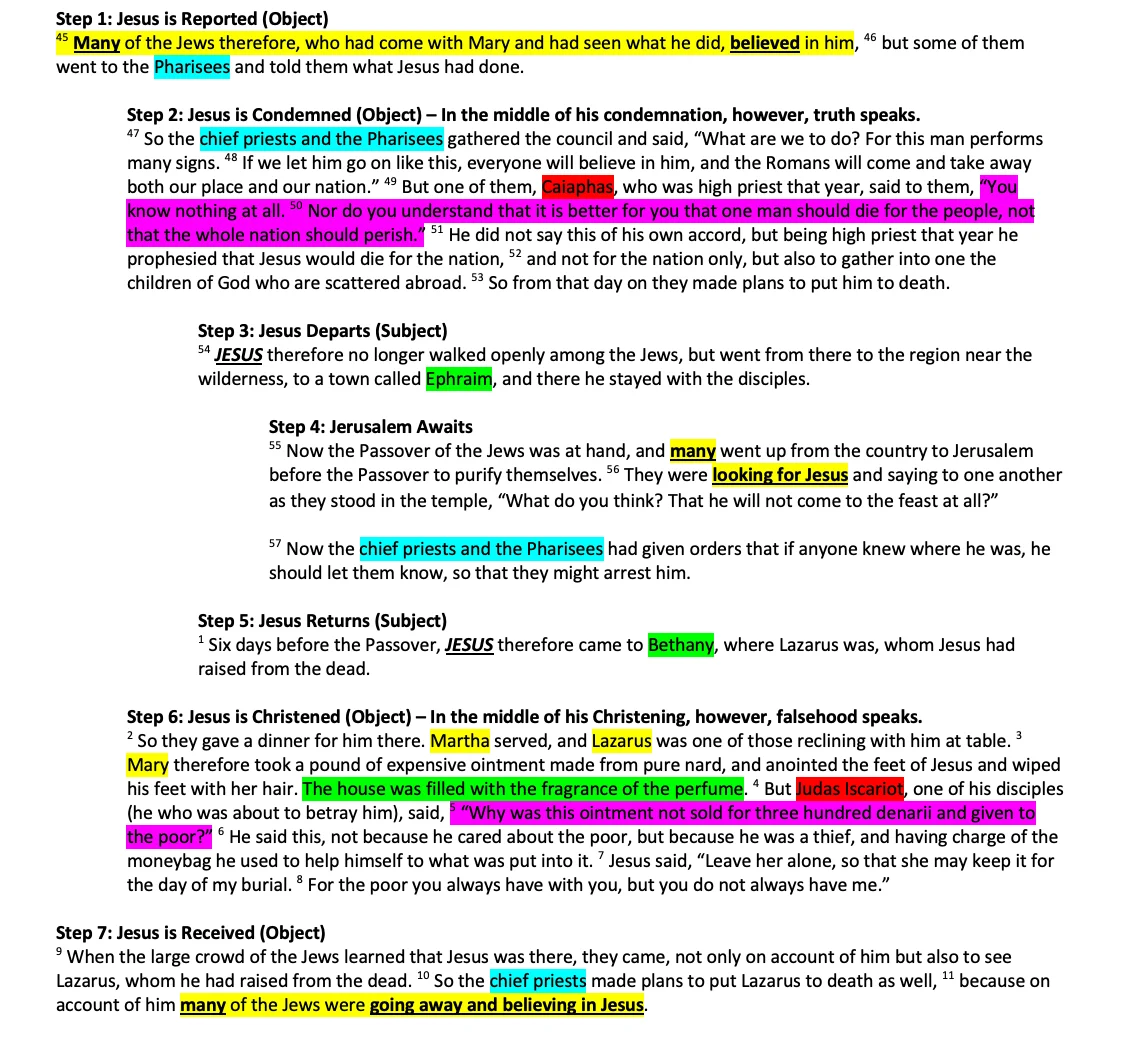
 Throughout John's Gospel, we have observed chiastic structures. Not surprisingly then, it appears John 11:45–12:11 is another place where the action is laid out in a seven step chiasm. Here's my structure. Below, I have listed some of the interpretive ramifications of this outline.
 Six Observations from John 11:45–12:11
1. Two Responses
In response to the resurrection of Lazarus and the one who raised him from the dead, there is an ongoing division between “many . . . believers” and the Pharisees. Consider a few places where we see this.
- The opening scene begins with a mixed response to Lazarus’s resurrection—there are many who believe and some who report Jesus (11:45).
- The two large narratives are also set at odds—the chief priests condemn Jesus (11:47–53) and are set opposite to the faithful who delight in Mary anointing Jesus (12:2–8).
- In the center on the narrative, Jerusalem is divided—there are many looking for Jesus (11:55–56) and there are many looking to arrest and kill Jesus (11:57; cf. 11:53).
- The final portion of this section continues the division—the chief priests look to kill Lazarus too, while many believe in Jesus (12:9–11)
- Among the chief priests, Caiaphas the high priest speaks up and calls for Jesus's death (11:49–50).
- Among the believers there is an imposter, Judas, who questions Mary and her devotion to Christ (12:4–5).
- The presence of unbelievers in both places tells us the work of Christ's salvation and judgment is still ongoing. By the end of the Gospel, the division will be clear, as Jesus brings all things to light.
- In 11:54 Jesus departs to Ephraim, a town unmentioned throughout the rest of the New Testament. That said, Ephraim is a significant word in the Bible, as it is often used to speak of the ten Northern tribes (see Hosea, where Ephraim is used of the ten tribes thirty-seven times).
- In 12:1 Jesus return to Bethany, the place where Lazarus was raised. It is likely that the connection between resurrection and Ephraim draws on Ezekiel 37, where the resurrection of the dead (vv. 1–14) is paired with the promise of reuniting Ephraim and Judah (vv. 15–28).
- If this is the case, and it is supported by the fact that there are disciples in Ephraim and Bethany. This means that in John’s Gospel we have a picture of Israel being reunited. Further evidence for this reading: Earlier in John 2–4, Jesus goes from Jerusalem to Galilee and Samaria, showing how he is bringing people to faith from all parts of the land. Later in John’s Gospel, such wide ranging faith will be seen as the Gentiles come to find Jesus (see 12:20–26).
- This central division is reinforced by the beginning and the end, as well as the two opposing narratives. See #1.
- Additionally, “many” is probably a reference to Isaiah 53:10–12. This is supported by the inclusion of Isaiah 53:1 in John 12:38.
- Bethany, which means “house of affliction/poor” is now filled with a rich fragrance.
- Judas, a lover of riches, laments the use of rich perfume on Christ. Ironically, he feigns a love for the poor, when in fact he is despising the poor around him who are trusting in Christ. N.B. Ptochos (Grk, poor) is the word that often translates ani (Heb. poor).
- Jesus replies by confirming his mission: He did not come to alleviate physical poverty; he came to raise the dead to life. Even more, he came to the poor to make them rich—and that richness is found in him.
Jesus Continues to Separate Believers from Unbelievers
All in all, John 11:45–12:11 continues to separate believer from unbeliever—a prominent theme in John. And when we see the structure of this passage, it helps us to see how the Apostle is showing the way Christ did that. He does the same today, as his gospel goes to the end of the earth. Accordingly, John's Gospel calls us to pledge our allegiance to Christ. In this passage, Caiaphas and Judas both show their love for their place (11:48) and their money (12:6). May we learn from their unbelief (cf. 1 Cor. 10:1–11) and eschew our loves of this world in order to trust and obey and love and follow Christ. Soli Deo Gloria, ds Photo by Joshua Hurricks on Pexels.comLeave a comment
Comments are read before they appear. Your email is never published.