August 19, 2016 · 17 min read
'Do Not Muzzle the Ox': A Logical, Intra-biblical, and Eschatological (but not Allegorical) Reading of Deuteronomy 25:4 in 1 Corinthians 9:9
 Do I say these things on human authority? Does not the Law say the same? For it is written in the Law of Moses, “You shall not muzzle an ox when it treads out the grain.” Is it for oxen that God is concerned? Does he not certainly speak for our sake? It was written for our sake, because the plowman should plow in hope and the thresher thresh in hope of sharing in the crop,
– 1 Corinthians 9:8–10 –
Do I say these things on human authority? Does not the Law say the same? For it is written in the Law of Moses, “You shall not muzzle an ox when it treads out the grain.” Is it for oxen that God is concerned? Does he not certainly speak for our sake? It was written for our sake, because the plowman should plow in hope and the thresher thresh in hope of sharing in the crop,
– 1 Corinthians 9:8–10 –
Allegorical Literature vs. Allegorical Interpretation
In truth, there are in Scripture elements of allegory. When Jesus explains some of his parables by saying, “The field is the world, and the good seed is the sons of the kingdom. The weeds are the sons of the evil one, 39 and the enemy who sowed them is the devil” (Matthew 13:38–39), he is speaking in allegory. Allegory by definition isA work of literature in which many of the details have a corresponding “other” meaning. The basic technique is symbolism in the sense that a detail in the text stands for something else. Interpreting an allegorical text must not be confused with allegorizing the text. To interpret an allegorical text is to follow the intentions of the author. Allegorizing a text implies attaching symbolic meanings to a text that was not intended by the author to be allegorical.[2]This distinction between between allegorical literature (e.g., The Pilgrim’s Progress) and allegorical methods of interpretation (e.g., Origen’s approach to the Bible) is one of the most confused and confusing aspects of modern evangelical hermeneutics. To be sure, Scripture includes multiple instances of allegory.
- When Jotham told his story of the bramble who would be king, he used allegory (Judges 9).
- When Nathan confronted David in his sin with Bathsheba, he employed allegory (2 Samuel 7).
- When Jesus told his parables he often intended for one element (“the field”) to stand for another (“the world”). This is allegory.
- Paul even understands the story of Sarah and Hagar (Genesis 16ff) to be written “allegorically” (Galatians 4).[3]
Logical, Intra-biblical, Eschatological: Tracing Paul's Argument
Following the lead of John Calvin, Richard Hays, and others, I will argue that Paul’s use of Deuteronomy 25:4 is (1) logical in its structure (not fanciful), (2) textual (not twisting the original context of Deuteronomy), and (3) theological (specifically, eschatological). But in no way is it allegorical. 1. The Structure of 1 Corinthians 9 For starters, we need to see how Paul’s quotation of Deuteronomy 25:4 fits into the logical structure of his argument. Kenneth Bailey likens the shape of 1 Corinthians 9 to that of a “high jump”: verses 1 and 2 provide the approach (the run up), verses 3–9a the ascending jump, verse 9b (the quotation) the peak of the jump, where the athlete crosses the bar, followed by the descent in verses 9c–12a.[4] From another angle, verses 3–12 provide a tightly argued chiastic “defense” (v. 3) where Paul strings together five arguments (see below):- The outer rings (Arguments #1 and #5) speak personally (“we”) about “rights.”
- The inner rings (Arguments #2 and #4) use cultural/vocational illustrations (e.g., soldier, planter, shepherd, plowman, and thresher).
- The center of the argument (Argument #5) stands on the Old Testament Law, namely Deuteronomy 25:4.
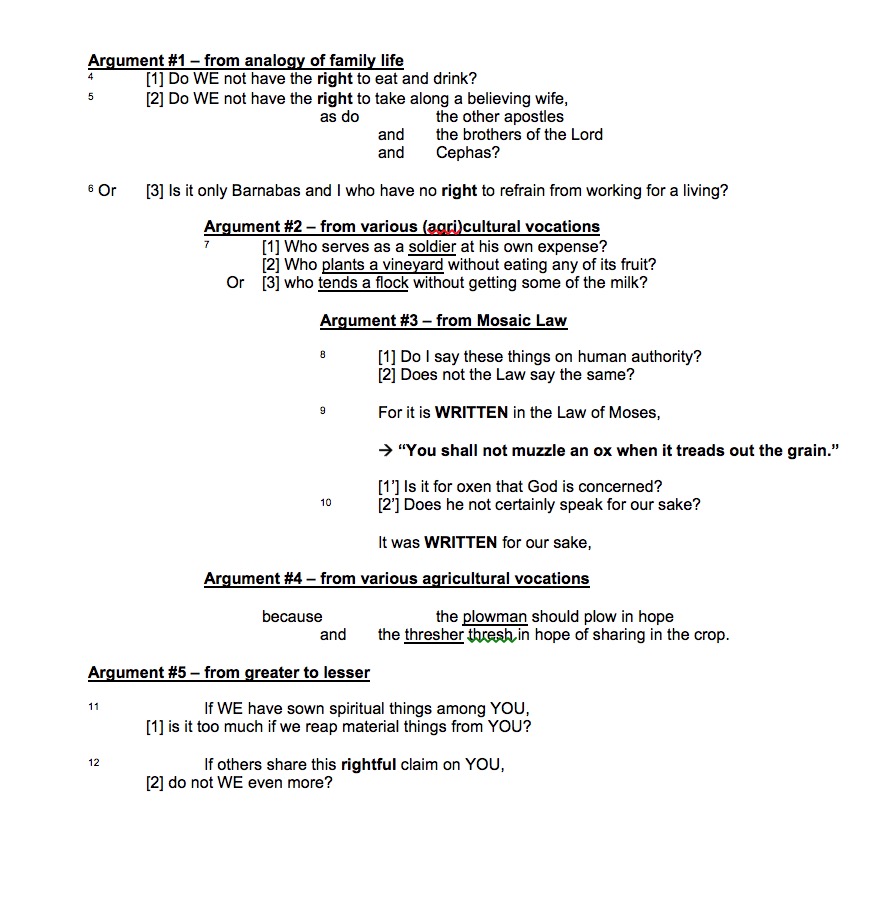 From this structure, we find the care with which Paul makes his argument. He is not simply issuing a stream of conscience argument. His logic is precise as he anticipates objections and grounds everything in the words from Moses. For this reason, I don’t believe his “defense” is offering a fanciful reading of Deuteronomy, but a tightly-reasoned, rationale case from the Law itself. In other words, the genre of Paul’s own writing militates against an allegorical reading.
2. The Background of Deuteronomy 24–25
If Paul is not allegorizing Moses words, what is he doing? I believe he is reading Moses authorial intent. Consider what Paul says. In 1 Corinthians 9:7, Paul lists three vocations from the culture of Corinth; he will add two more in verse 10. These cultural illustrations show the folly of letting workers benefit from the fruit of their labor, but depriving Paul his due. Apparently, the church which Paul planted should have been sharing its produce with him, but was not. Verses 1–12 attend to this matter, as Paul argues for the apostles right to receive remuneration, even as he will refuse such support when he concludes his argument (vv. 12, 15, 18).
Still, in the flow of his argument, he does not depend most heavily on the cultural norms of paying soldiers and letting workers eat of their labors (vv. 7, 10). Rather, he turns to the Old Testament where he finds a passage of Scripture that makes his point for him. In fact, it is a verse he quotes more than once. When tackling the subject of pastors receiving compensation from the flocks they serve in 1 Timothy 5:18, he quotes Deuteronomy 25:4. Why does Paul quote this passage? What does Paul see?
The answer becomes fairly obvious when we read the immediate context of Deuteronomy 24:17–25:4.
From this structure, we find the care with which Paul makes his argument. He is not simply issuing a stream of conscience argument. His logic is precise as he anticipates objections and grounds everything in the words from Moses. For this reason, I don’t believe his “defense” is offering a fanciful reading of Deuteronomy, but a tightly-reasoned, rationale case from the Law itself. In other words, the genre of Paul’s own writing militates against an allegorical reading.
2. The Background of Deuteronomy 24–25
If Paul is not allegorizing Moses words, what is he doing? I believe he is reading Moses authorial intent. Consider what Paul says. In 1 Corinthians 9:7, Paul lists three vocations from the culture of Corinth; he will add two more in verse 10. These cultural illustrations show the folly of letting workers benefit from the fruit of their labor, but depriving Paul his due. Apparently, the church which Paul planted should have been sharing its produce with him, but was not. Verses 1–12 attend to this matter, as Paul argues for the apostles right to receive remuneration, even as he will refuse such support when he concludes his argument (vv. 12, 15, 18).
Still, in the flow of his argument, he does not depend most heavily on the cultural norms of paying soldiers and letting workers eat of their labors (vv. 7, 10). Rather, he turns to the Old Testament where he finds a passage of Scripture that makes his point for him. In fact, it is a verse he quotes more than once. When tackling the subject of pastors receiving compensation from the flocks they serve in 1 Timothy 5:18, he quotes Deuteronomy 25:4. Why does Paul quote this passage? What does Paul see?
The answer becomes fairly obvious when we read the immediate context of Deuteronomy 24:17–25:4.
You shall not pervert the justice due to the sojourner or to the fatherless, or take a widow’s garment in pledge, 18 but you shall remember that you were a slave in Egypt and the Lord your God redeemed you from there; therefore I command you to do this. 19 “When you reap your harvest in your field and forget a sheaf in the field, you shall not go back to get it. It shall be for the sojourner, the fatherless, and the widow, that the Lord your God may bless you in all the work of your hands. 20 When you beat your olive trees, you shall not go over them again. It shall be for the sojourner, the fatherless, and the widow. 21 When you gather the grapes of your vineyard, you shall not strip it afterward. It shall be for the sojourner, the fatherless, and the widow. 22 You shall remember that you were a slave in the land of Egypt; therefore I command you to do this. “If there is a dispute between men and they come into court and the judges decide between them, acquitting the innocent and condemning the guilty, 2 then if the guilty man deserves to be beaten, the judge shall cause him to lie down and be beaten in his presence with a number of stripes in proportion to his offense. 3 Forty stripes may be given him, but not more, lest, if one should go on to beat him with more stripes than these, your brother be degraded in your sight. 4 “You shall not muzzle an ox when it is treading out the grain.From a cursory reading, we can observe at least three commonalities between Deuteronomy 25:4 (i.e., the oxen verse) and 1 Corinthians 9:10.
- The subjects in view are men, not animals. The oxen verse is the only one which speaks of animals. Therefore, Paul is entirely justified when he insinuates that God is more concerned for men than animals (“Is it for oxen that God is concerned?” v. 9)
- The setting is that of justice for the oppressed. Many are the commands to ensure foreigners and workers receive their wages (24:19–21). In the same way, Paul is addressing the justice of churches withholding support from those who rightly deserve it.
- The oxen verse is the final statement in this section. Deuteronomy 25:5 enters a new section, as it turns to levirate marriages. Accordingly, in our English versions, the oxen verse may function as a grounding text at the end of its paragraph.
When he says, that God does not take care for oxen, you are not to understand him as meaning to exclude oxen from the care of God's Providence, inasmuch as he does not overlook even the least sparrow. (Matthew 6:26, and Matthew 10:29.) Nor is it as if he meant to expound that precept allegorically, as some hair-brained spirits take occasion from this to turn everything into allegories. Thus they turn dogs into men, trees into angels, and turn all scripture into a laughing-stock. Paul's meaning is simple -- that, when the Lord enjoins humanity to oxen, he does not do it for the sake of oxen, but rather from a regard to men, on whose account, too, the very oxen were created. That compassion, therefore, towards oxen should be a stimulus to us to stir up to the exercise of humanity among us.[6]3. The Eschatological Shift in Redemptive History Finally, we should note that Paul is doing more than directly applying a principle from the Old Testament to the New Testament church. In historical context, the oxen verse is set in the covenantal context of Israel in the land. Moses writes in Deuteronomy with his eyes set on the Promised Land—literally, he stands on the Plains of Moab preparing Israel to enter the land. In this setting, he instructs the Israelites how they are to treat foreigners and the disenfranchised when they get into the land. He calls them to remember their previous condition (slavery) and God’s gracious work (of salvation), so that they would treat the nations with compassion. In 1 Corinthians, the context has shifted. No longer is the oxen verse set in the friendly confines of Israel, it is being applied in pagan Corinth. Likewise, the covenant God made with Israel has been superseded by the new covenant (see Hebrews 8–10). In 1 Corinthians itself, Paul opens his letter with an allusion to Malachi 1:11. Compare the way in which he uses “in every place” and the Lord’s “name.”[7]
Malachi 1:11 – “For from the rising of the sun to its setting my name will be great among the nations, and in every place (ἐν παντὶ τόπῳ) incense will be offered to my name, and a pure offering. For my name will be great among the nations, says the Lord of hosts.”
1 Corinthians 1:2 – “To the church of God that is in Corinth, to those sanctified in Christ Jesus, called to be saints together with all those who in every place (ἐν παντὶ τόπῳ) call upon the name of our Lord Jesus Christ.”
From this perspective, we should read 1 Corinthians as a letter that addresses a people who fulfill this promise. No longer is it a future reality that the nations would stream into Zion; through the preaching of the gospel, the nations have come to be a part of God’s new covenant people. In fact, Paul goes further. He explains that what was written by Moses was not just written for Israel, but for those one whom the end of the ages have come. This is his explicit statement in 1 Corinthians 10:11, when he points to Israel and an example preserved in Scripture for the predominately-Gentile Corinthian church. Paul does the same thing, however, in 1 Corinthians 9:10. As Paul turns to emphasize the right he has as an apostle to “reap material things” in verses 11–12, we can see that emphasis begins in verse 10, when he says, “It was written for our sake.” On this point, Hays makes a point “rarely appreciated by interpreters of 1 Corinthians.”[8] Paul is not just claiming that the biblical verse applies to human laborers in general; rather, “It was indeed written for our sake,” that is, for the sake of the church in Paul’s own time [cf. 1 Corinthians 10:11]. The first person plural pronoun of verse 10 (“written for our sake) has the same implied antecedent as the first person plural pronoun of verse 11: Paul and his associates in ministry. “If we have sown spiritual things among you, is it a big thing if we reap material things among you?” (v. 11). Thus, Paul claims the text addresses the church of his own time directly, in an oracular fashion, metaphorically instructing them to provide financial support for Paul and other apostles. This is for Paul not a derived sense of the text, but its fundamental meaning, now eschatologically disclosed.[9] If Hays is correct about this reading, and I am persuaded he is, then Paul’s use of Deuteronomy 25:4 is both analogical and covenantal, or better it is analogical via the new covenant. In other words, Paul does not merely principalize the Law of Moses, he argues that just as the workers under the law of Moses received material goods, so those laborers of the new covenant (i.e., ministers of the gospel) ought to receive the right to reap from the spiritual truths they sow. This, in fact, is the very way that Paul concludes his argument (vv. 11–12).Right Hermeneutics Leads to A Right Ecclesiology: Exegetical and Theological Implications
From this reading of 1 Corinthians 9 we learn two important truths. First, that Paul is in no way offering an allegorical reading of Deuteronomy 25:4, rather his exegetical methods display careful attention to the original context of Moses’ words. Moreover, his awareness of the covenantal changes that have occurred through the person and work of Jesus Christ, cast this Old Testament verse in the context of a new covenant people. To be sure, Paul’s interpretation brings together Old and New, Moses and Jesus, Jew and Gentile, and hence it reframes the original words of Moses, but it does so in keeping with the original intention and therefore without succumbing to any form of allegory. As Anthony Thiselton puts it,This is not an example of ‘allegorical interpretation.’ Paul conceives of Old Testament revelation as a historical unfolding of God’s will for his people. This has immediate application to Israel, but ultimately it also applies to the ‘true’ Israel of the people of God in Christ (who include many Jews who have come to Christian faith). Paul now explains this expression of God’s will for his people’s well-being. Work conditions are not to crush the human spirit, but to lift and to encourage it with thoughts of the benefits of the goal of labor. Hence plowing should take place in hope (v. 10).[10]Instead of giving us a model of allegorical exegesis to avoid, Paul provides an exemplary form of theological interpretation that we should imitate. Additionally, and this is the final point, Paul reminds us the identity of the Corinthian church and all Christian churches are neither a religious continuation of Israel, nor a replacement. Rather, springing from Christ, the true Israel, every church is a third race, a people called out from Israel and the nations to be united to Christ by their faith in the gospel (cf. 1 Corinthians 10:32). God created the the multi-ethnic Corinthian church when the gospel came to them through the apostolic ministry of Paul, and now as a new covenant community of faith they are called to provide for the gospel ministers that God gives to them. Just as the nation of Israel funded the Levites to serve in the temple, so local churches are called to provide for the bread and board of those who preach the gospel to them. In this way, the instruction to “not muzzle the ox” is one more way in which God calls churches to see themselves in covenant with God and in covenant with one another—analogous to Israel of old. Indeed, what is at stake in 1 Corinthians 9 is not just a case of rightly labeling Paul’s methodology; it is an understanding of who the church of Jesus Christ is. Thankfully, from a careful study of Paul’s approach we learn how he read the Old Testament and applied to Christ’s New Testament people. May we continue to study his words and imitates his ways. Soli Deo Gloria, ds For More Online Resources, See:
- Do Not Muzzle the Ox: Does Paul Quote Moses Out of Context by Justin Taylor (blogpost with many resources)
- Of Muzzles and Oxen: Deuteronomy 25:4 and 1 Corinthians 9:9 by Jan Verbugge (JETS Article)
Leave a comment
Comments are read before they appear. Your email is never published.